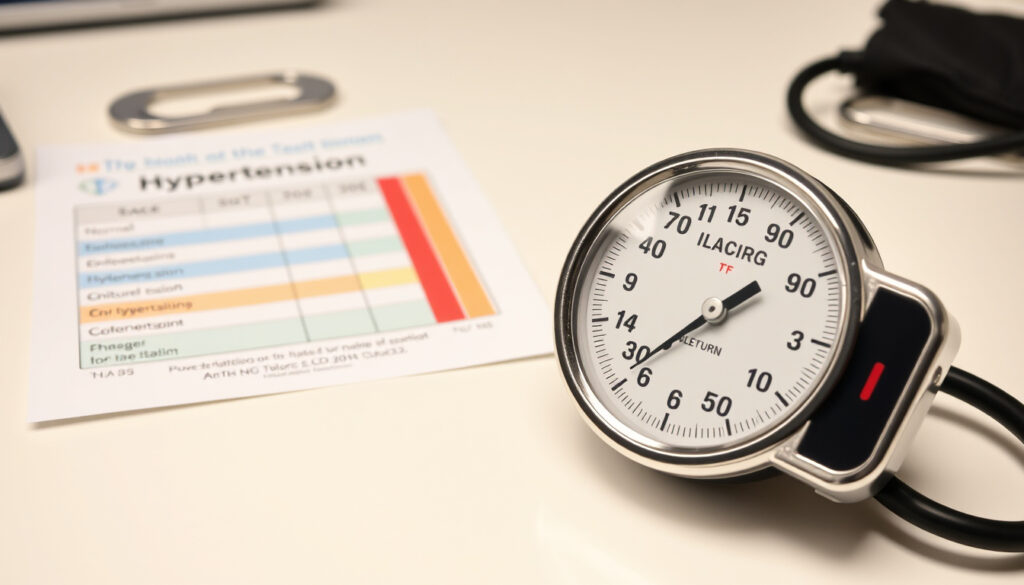
What Is Considered High Blood Pressure? Stages & Charts
Blood pressure readings can feel like a foreign language until someone translates the numbers into plain terms. Once you know which numbers matter, you can have a much smarter conversation with your doctor about where you actually stand.
Ideal blood pressure: <120/80 mmHg (American Heart Association) · Stage 1 high blood pressure: 130-139/80-89 mmHg (American Heart Association) · Stage 2 high blood pressure: ≥140/90 mmHg (Health Service Executive, Irish Heart) · Hypertensive emergency: >180/120 mmHg with symptoms (American Heart Association) · High for over 80: ≥150/90 mmHg (Health Service Executive)
Quick snapshot
- 140/90 mmHg marks high blood pressure across AHA, HSE, and Irish Heart (American Heart Association, HSE Ireland)
- Whether readings just below the hypertensive crisis threshold (>180/120) warrant the same urgency without symptoms varies by individual risk factors (American Heart Association)
- The 2017 AHA guideline shift lowered the “high BP” trigger from 140/90 to 130/80, a change still not adopted by the Irish HSE (AHA Journals)
- The 2025 AHA/ACC multi-society guidelines keep the four-tier structure: normal, elevated, stage 1, stage 2 (AHA Journals)
Blood pressure thresholds span two distinct systems worth knowing side by side.
| Category | Systolic (mmHg) | Diastolic (mmHg) | Source |
|---|---|---|---|
| Normal | <120 | <80 | American Heart Association |
| Elevated | 120–129 | <80 | American Heart Association |
| Stage 1 Hypertension | 130–139 | 80–89 | American Heart Association |
| Stage 2 Hypertension | ≥140 | ≥90 | American Heart Association |
| Severe / Hypertensive Crisis | >180 | >120 | American Heart Association |
| High BP (Ireland, adults) | ≥140 | ≥90 | HSE Ireland |
| High BP (Ireland, over 80) | ≥150 | ≥90 | HSE Ireland |
| Home reading threshold (HSE) | ≥135 | ≥85 | HSE Ireland |
| Ideal BP (Irish Heart) | <120 | <70 | Irish Heart Foundation |
| WHO Hypertension Stage 1 | 130–139 | 85–89 | PMC |
| 2024 ESC Elevated BP | 120–139 | 70–89 | AHA Journals |
The implication: the US and Ireland use different trigger points, and neither is “wrong” — they reflect different risk thresholds set by different health systems.
What is normal blood pressure by age?
Both the American Heart Association and the Health Service Executive apply the same stage categories to all adults, regardless of age. There are no official age-specific stages — only age-specific treatment targets, and those appear mainly for people over 80 (American Heart Association).
Normal ranges for adults
The Irish Heart Foundation states an ideal blood pressure as less than 120/70 mmHg (Irish Heart Foundation). The HSE puts the ideal window between 90/60 and 120/80 mmHg for adults generally (HSE Ireland). For adults in their 20s through 60s, the American Heart Association defines normal as systolic under 120 mm Hg and diastolic under 80 mm Hg — a uniform standard that doesn’t shift with birthday candles (American Heart Association).
Adjustments for seniors over 80
Where age does change the picture is in the Irish context for adults over 80. The HSE defines high blood pressure in this group as 150/90 mmHg or higher (or 145/85 mmHg when measured at home) (HSE Ireland). The treatment target for over-80s is below 150/90 mmHg in clinic or 145/85 mmHg at home — a more relaxed threshold than for younger adults, reflecting different risk-benefit calculations at that age (HSE Ireland).
Why this matters: the absence of official age-stage charts doesn’t mean age is irrelevant — it means your doctor’s decision about treatment targets is partly age-informed, even if the diagnostic labels stay the same.
Should I worry if my blood pressure is 150/80?
A reading of 150/80 mmHg sits in an interesting middle zone. The systolic of 150 is clearly elevated, but the diastolic of 80 is still within normal range — and that’s a combination worth unpacking.
Stage 2 classification
Under American guidelines, a systolic of 150 falls squarely in Stage 2 Hypertension territory because the systolic threshold for Stage 2 is 140 mmHg or higher, while the diastolic here (80) is below the Stage 1 threshold of 80–89 mmHg (American Heart Association). Under Irish HSE criteria, 150/80 also exceeds the high blood pressure threshold of 140/90 for general adults (HSE Ireland). The elevated systolic alone is sufficient to trigger a Stage 2 classification in both systems.
When to seek medical attention
At 150/80, you don’t need to call 911 — but you do need to schedule a follow-up appointment with your GP within days or weeks, not months. Hypertensive crisis (requiring immediate emergency care) only kicks in above 180/120 mmHg with symptoms such as chest pain, headache, shortness of breath, or neurological changes (American Heart Association). A systolic of 150, absent those symptoms, is a prompt doctor’s visit, not an emergency room visit.
The pattern: isolated systolic elevation — where the top number is high but the bottom number is normal — is particularly common in older adults and is itself a meaningful cardiovascular risk signal that doctors take seriously (PMC).
A reading of 150/80 isn’t an ER situation, but it is a Stage 2 signal that typically requires both lifestyle changes and medication under standard guidelines (American Heart Association).
What do I do if my BP is 140/90?
A reading of 140/90 mmHg is the most widely recognized dividing line in blood pressure medicine — and it’s also where the US and Irish guidelines begin to diverge on what happens next.
Immediate actions
The HSE defines high blood pressure as 140/90 mmHg or higher for adults, or an average of 135/85 mmHg when measured at home (HSE Ireland). At this level with a low cardiovascular risk profile, the HSE first recommends lifestyle changes: reducing salt intake, increasing physical activity, managing alcohol consumption, and maintaining a healthy weight (HSE Ireland). Medicine is offered if blood pressure remains above 140/90 with elevated cardiovascular risk, or above 160/100 mmHg regardless of risk (HSE Ireland).
ER threshold
At 140/90 alone, there is no medical reason to go to an emergency room. This is true regardless of whether you’re following AHA or HSE guidelines. Hypertensive crisis — the condition that warrants calling 911 — begins only above 180/120 mmHg with accompanying symptoms (American Heart Association). However, if 140/90 appears alongside chest pain, severe headache, visual changes, shortness of breath, or neurological symptoms, then yes — call 112 or 999 immediately.
The HSE and AHA converge on one point: 140/90 is a threshold that warrants action. Where they differ is on what triggers that action below it. The AHA labels 130/80 as Stage 1, while the HSE doesn’t flag it as high.
What is stroke level blood pressure?
Stroke risk and blood pressure are tightly linked — but pinpointing a single “stroke-level” reading requires some context, because the risk operates on a spectrum, not a cliff.
Hypertensive crisis thresholds
The American Heart Association designates hypertensive crisis as readings above 180/120 mmHg — and at that level, the risk of a cardiovascular event including stroke rises steeply (American Heart Association). Above this threshold, professional medical contact is required within minutes — and if symptoms such as chest pain, back pain, shortness of breath, or numbness are present, the recommendation is to call emergency services immediately (American Heart Association).
Associated risks
The FDA notes that high blood pressure is one of the most powerful modifiable risk factors for stroke — meaning that sustained elevations, not just single crisis readings, drive the danger. Sustained readings of 140/90 mmHg or higher over time correlate with increased stroke risk, even if no single reading is at crisis level (American Heart Association). The American Heart Association classifies the relationship between sustained high BP and stroke as well-established in the medical literature (American Heart Association).
The pattern: there is no single “stroke number” — rather, sustained high blood pressure (whether 140/90 over months or >180/120 acutely) is the common thread running through stroke risk.
For patients with a history of cardiovascular disease or high stroke risk, any sustained reading above 140/90 warrants a conversation with a GP about treatment escalation — not just a note to check again tomorrow.
What are warning signs of high blood pressure?
Here is the uncomfortable truth about high blood pressure: it frequently announces itself with silence. That is precisely why it has earned the nickname “the silent killer.”
Common symptoms or lack thereof
The FDA classifies high blood pressure as a silent condition — meaning most people experience no symptoms at all until the condition is severe or complications have already begun (American Heart Association). By the time symptoms appear, organ damage may already be underway. When symptoms do occasionally occur, they can include headaches (particularly in the morning), dizziness, nosebleeds, shortness of breath, or visual changes — but these are nonspecific and easily attributed to other causes (HSE Ireland).
Silent killer explanation
Because high blood pressure causes no obvious pain in its early stages, it can silently damage blood vessels, the heart, and other organs over years before being detected. This is why screening — especially for people over 40 or with a family history — is the only reliable early detection tool available. The HSE recommends checking blood pressure at least once a year for adults 40 and older, and every five years for those aged 18–39 with no family history and no risk factors (HSE Ireland).
The implication: symptoms are not a reliable alarm for high blood pressure. The numbers are. A home monitor or a clinic reading is worth far more than waiting to “feel” something.
What we know — and what we don’t
Confirmed
- 140/90 mmHg is the universal high-BP threshold across AHA, HSE, and Irish Heart
- Hypertensive crisis requiring emergency contact begins at >180/120 mmHg with symptoms
- High blood pressure is typically asymptomatic — earning the “silent killer” label
- The AHA introduced Stage 1 at 130/80 in 2017; the HSE still uses 140/90 for Irish adults
- Irish adults over 80 have an adjusted threshold of 150/90
Less certain
- Whether the 2017 AHA threshold shift (130/80) will eventually be adopted by Irish guidelines — no timeline announced
- Whether individual cardiovascular risk factors alter the clinical urgency of readings just below crisis level but above 140/90
“Your blood pressure is considered high (stage 1) if it reads 130 to 139 mmHg/80 to 89 mmHg. Stage 2 high blood pressure is 140/90 or higher.”
— US Food and Drug Administration (American Heart Association)
“High blood pressure is 140/90mmHg or higher (or an average of 135/85mmHg at home). If you’re over the age of 80, high blood pressure is 150/90mmHg or higher.”
— Health Service Executive Ireland (HSE Ireland)
“If they confirm a diagnosis of high blood pressure Stage 1, they should prescribe lifestyle changes. They may add medication based on your risk of heart disease or stroke.”
— American Heart Association (American Heart Association)
Related reading: Apple Watch Blood Pressure Hypertension Alerts
Frequently asked questions
Can drinking water lower blood pressure?
Staying well-hydrated supports overall cardiovascular health, but there is no strong evidence that drinking water alone lowers blood pressure to normal range. Dehydration can temporarily raise blood pressure, so adequate fluid intake is a baseline health habit rather than a treatment for hypertension. If your doctor has diagnosed high blood pressure, water intake alone is not a substitute for prescribed treatment.
What time of day is blood pressure highest?
Blood pressure follows a circadian pattern, typically peaking in the morning hours between 6 a.m. and noon. This is one reason morning readings are often higher and why morning hypertension monitoring matters. The HSE notes that home readings of 135/85 or higher on average warrant discussion with a GP — and morning readings are frequently the ones that trigger that concern.
What is a normal blood pressure for a woman?
There are no separate diagnostic thresholds specifically for women. The same AHA and HSE thresholds apply to adult women and men. Pregnancy can create temporary BP variations, and some conditions that disproportionately affect women (such as preeclampsia) have their own BP monitoring protocols. For a healthy adult woman, “normal” follows the same 120/80 ideal and 140/90 high threshold as for men.
What is normal blood pressure by age in Ireland?
No official HSE chart assigns different stage thresholds by specific age bands. The HSE uses a uniform adult threshold of 140/90 (or 135/85 at home), with one exception: adults over 80 face an adjusted threshold of 150/90. For everyone else, age-based differences appear in treatment targets and screening frequency, not diagnostic categories.
How will you feel if your blood pressure is too high?
In most cases, you won’t feel anything at all — that is the defining danger of high blood pressure. When symptoms do appear, they are nonspecific and easily missed: morning headaches, brief dizziness, nosebleeds, or mild shortness of breath. By the time symptoms are noticeable enough to prompt a doctor’s visit, organ damage may already be in progress. Regular BP checks are the only reliable detection method.
What causes high blood pressure?
High blood pressure typically develops without a single identifiable cause — this is called primary or essential hypertension and accounts for the majority of cases. Contributing factors include genetics, age, salt intake, physical inactivity, alcohol use, stress, and obesity. A smaller number of cases (secondary hypertension) have a specific identifiable cause such as kidney disease, thyroid disorders, or certain medications. The Irish HSE recommends lifestyle modifications as a first-line approach for most adults with elevated readings.
What are the four signs your heart is quietly failing?
Heart failure often develops gradually and can be subtle. Four early warning signs to watch for: increasing shortness of breath during normal activities or at rest, persistent swelling in the ankles, feet, or abdomen, unexplained fatigue that limits daily activities, and sudden weight gain from fluid retention. High blood pressure is one of the most common preceding conditions for heart failure — which is why monitoring and treating BP matters long before symptoms appear.
For Irish adults, the takeaway is direct: a reading of 140/90 or higher means high blood pressure, whether you’ve been following US guidelines or not. Get checked, track your numbers at home, and have that conversation with your GP — because the risk that runs without symptoms is still running.
More related posts
 Jayden Daniels Arm Injury: MRI Results & Recovery Timeline
 Treat Williams Movies and TV Shows: Complete Filmography
 Bill Belichick Net Worth 2025: Salary, Career Earnings & More
 Paris Saint-Germain Finances: Revenue, Mbappé, Richest Club
 Quick Pickled Red Onions: 3 Easy Methods (No Cook to Hot Brine)
 Independent Living Near Me: Costs, Options & Financial Tips 2025
 High White Blood Cell Count: Causes, Symptoms & When to Worry
 Chicken à la King: History, Recipe, and Cooking Tips
