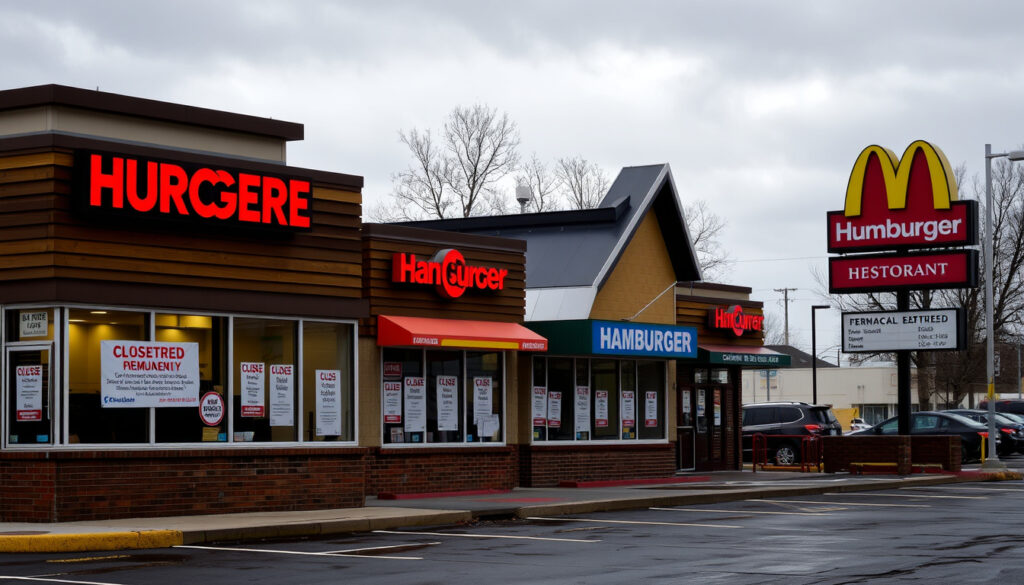
Hamburger Chain Restaurant Closures Sweep US 2025-2026
If you’ve noticed empty parking lots where your local burger joint used to sit, you’re not imagining things. Several major hamburger chains are trimming their US footprints in 2025 and 2026 — and the numbers are significant. Wendy’s alone is targeting up to 350 closures next year, while Jack in the Box and Red Robin are also pulling back from underperforming markets. This wave of shutterings reflects broader economic pressures hitting the fast-food industry, and the impacts are anything but uniform across the country.
Wendy’s planned closures: 300–350 by 2026 · Jack in the Box closures: 150–200 through mid-2026 · Red Robin 2025 closures: 23 locations
Quick snapshot
- Wendy’s plans 300–350 closures in 2026 (Restaurant Dive)
- Jack in the Box closed 86 units in fiscal 2025 (Restaurant Dive)
- Red Robin closed 23 locations in 2025 (Tasting Table)
- Which specific Wendy’s locations will close
- Exact count of Red Robin’s remaining planned closures
- Whether Jack in the Box will meet its full 150–200 target
- Wendy’s announced closures in January 2026, targeting first half of the year
- Jack in the Box shifts remaining closures to 2026 after missing 2025 targets
- Red Robin resumed abrupt closures by early 2026
- Jack in the Box expects 50–100 more closures by January 2026
- Red Robin aims for roughly 440 locations after planned closures
- Wendy’s Mexico expansion continues despite US pullback
The table below summarizes key metrics from the major hamburger chains’ closure announcements.
| Metric | Value |
|---|---|
| Top closure announcement | Wendy’s: 300–350 locations by 2026 |
| Largest planned scale | Jack in the Box: 150–200 total through mid-2026 |
| Jack in the Box fiscal 2025 closures | 86 units (47 in Q4 alone) |
| Red Robin 2025 closures | 23 locations against planned 70 |
| Wendy’s US footprint end-2025 | 5,969 locations |
| Jack in the Box Q1 fiscal 2026 count | 2,128 restaurants |
| Jack in the Box nearby sales lift | 30% post-closures |
Why is Wendy’s closing hundreds of restaurants?
Wendy’s announced in December 2025 that it plans to close between 300 and 350 underperforming US locations in 2026 — representing roughly 5–6% of its domestic footprint of 5,969 stores. The chain already closed 28 restaurants in Q4 2025, ending the year with that count. The closures target locations that are dragging down franchisee economics, evaluated on a store-by-store basis rather than by region.
Planned timeline for 2026 closures
The announcement came with a clear target window: the first half of 2026. Unlike some competitors, Wendy’s hasn’t released a public list of specific locations. Franchisees will receive individual notices as decisions are finalized. This approach lets the company avoid panicking markets before deals are confirmed.
Affected locations
No comprehensive list exists yet, but industry analysts note that same-store sales dropped 10% globally in Q4 2025, with an even steeper decline in the US market. That performance pressure is the engine driving these cuts. Meanwhile, Wendy’s is simultaneously expanding in Mexico, with plans for 60 new locations — a reminder that growth and contraction can coexist under the same brand.
The implication: Wendy’s is willing to shrink its domestic presence to protect the profitability of stores it keeps. For franchisees, that means fewer neighbors competing for the same customers. For communities losing a location, it means recalculating where your nearest burger comes from.
What restaurant chains are closing?
Beyond Wendy’s, two other hamburger chains have made headlines with significant closure announcements in 2025–2026. Jack in the Box is mid-execution on its “Jack on Track” restructuring plan, while Red Robin has been more sporadic, closing sites abruptly in early 2026 after scaling back an earlier round of cuts.
Jack in the Box shutdowns
Jack in the Box closed 86 units in fiscal 2025 — including 47 in Q4 alone — but fell short of its initial target. The chain planned to shut 150–200 restaurants but only managed 72 by year’s end, reportedly due to franchisee negotiations and operational delays. That shifted 50–100 closures into 2026, with expectations of 20 new openings to partially offset the losses. By the end of Q1 fiscal 2026, the chain operated 2,128 restaurants.
Dawn Hooper, Jack in the Box CFO, noted that Restaurants nearby closed units are seeing a roughly 30% sales lift.
Red Robin locations
Red Robin operates nearly 500 US locations as of early 2026, down from a higher count after closing 23 sites in 2025. The chain had originally considered shutting 70 restaurants but reduced that number after its Big Yum Value Meal promotion boosted performance. By early 2026, abrupt closures resumed in Illinois, California, and New Jersey — suggesting that the reprieve was temporary. An estimated 27 locations remain on the closure list for future action, bringing the chain’s long-term target down to roughly 440 stores.
Other US chains
Jack in the Box is also dealing with $1.7 billion in debt repayment and elevated beef costs that are squeezing margins across its system. One Arizona franchisee closed four locations due to expiring lease agreements and ADA renovation requirements — a reminder that not all closures trace back to corporate strategy. Some are simple real estate math.
Wendy’s Is Closing Hundreds of Restaurants in 2026 (Is Yours One?)
Wendy’s move is the largest by a hamburger chain in this cycle, but it raises a practical question for customers: how do you know if your local Wendy’s is on the list? The honest answer is that no public tracker exists yet. The company evaluates locations individually and issues notices as decisions solidify.
How to check your local Wendy’s
Your best bet is to call the restaurant directly or check the store locator on Wendy’s website — closed locations typically disappear from the finder within days of shutting. If a store closes, the nearest surviving location often gets a 30% sales boost, according to industry data from comparable chains — a statistic that underscores how concentrated demand can be even in shrinking networks.
List of closures
No single list aggregates every closing Wendy’s location. Reports suggest locations are evaluated on profitability metrics, with some franchisees already confirming they have received notices. The lack of a centralized public database is a gap the industry hasn’t filled — leaving communities to find out by showing up to locked doors.
What this means: if your Wendy’s closes, you probably won’t get much warning. The company hasn’t committed to pre-announcing specific addresses. The practical move is to check before your next craving — and if it’s gone, expect your nearest remaining location to get noticeably busier.
Restaurants closing permanently in 2025
The closures aren’t evenly distributed across the industry. Some chains moved faster in 2025; others held off and are now accelerating into 2026. Looking at the timeline, the hamburger segment has been in active restructuring mode for roughly a year, with announcements clustering around earnings calls and franchisee conferences.
US hamburger chains timeline
- Early 2025: Jack in the Box announces “Jack on Track” strategy, targeting 150–200 closures
- January 2026: Jack in the Box begins executing 80–120 closures planned for the year
- 2025: Red Robin considers 70 closures but scales back after Big Yum Value Meal success
- Q4 2025: Wendy’s closes 28 restaurants
- Fiscal 2025: Jack in the Box reports 86 total closures
- 2025: Red Robin closes 23 locations
- March 2026: Wendy’s announces 300–350 closures for first half of 2026
UK burger chain examples
While this article focuses on US chains, the trend isn’t American-exclusive. MeatLiquor, a UK hamburger chain, entered administration in recent weeks, closing most of its sites and leaving only two or three remaining. That’s a smaller market story, but it illustrates the same pressures — inflation, labor costs, and shifting consumer preferences — hitting burger chains on both sides of the Atlantic.
The catch: US chains have more financial cushion from scale, but they’re also held to stricter franchisee performance standards. A UK chain entering administration can shed locations fast; a US chain negotiating closures must navigate franchise agreements, debt terms, and franchisee pushback.
What restaurant chains are closing locations like Red Robin?
Red Robin’s closures deserve their own attention because they’re less structured than Jack in the Box’s plan and more abrupt than Wendy’s timeline. The chain closed 23 restaurants in 2025 after publicly considering 70 — then surprised observers by resuming abrupt shutdowns in Illinois, California, and New Jersey in early 2026.
Red Robin closures list
Red Robin has roughly 470 restaurants as of 2026, down from nearly 500 at the start of the year. The chain’s long-term target sits around 440 after planned future closures. The 27 locations still flagged for closure represent the remainder of an earlier consolidation push that lost momentum. Whether those 27 close in 2026 or get pushed further depends on whether the turnaround story holds.
Patterns across chains
Three patterns emerge across Wendy’s, Jack in the Box, and Red Robin: first, performance-driven decisions replace intuition-based site selection. Second, closures benefit surviving locations more than they harm the brand. Third, the timelines keep slipping — Jack in the Box planned 200 closures by end-2025 and delivered 72, for example. These chains announce ambitious targets but negotiate actual outcomes over months.
Ken Cook, Wendy’s CFO and interim CEO, explained that close underperforming stores to allow franchisees to increase focus on locations with the greatest potential for growth.
For franchisees, the message is clear: the brand is willing to cut dead weight to protect margins. For customers, the implication is fewer options in underperforming markets — and possibly longer drives to your next Frosty.
Timeline of hamburger chain closures
Key events in the hamburger chain restructuring timeline are listed below.
| Period | Event |
|---|---|
| 2025 | Jack in the Box announces “Jack on Track” strategy |
| January 2026 | Jack in the Box begins planned 80–120 closures |
| 2025 | Red Robin considers 70 closures but reduces plans |
| Q4 2025 | Wendy’s closes 28 restaurants |
| Fiscal 2025 | Jack in the Box closes 86 total units |
| 2025 | Red Robin closes 23 locations |
| January 2026 | Wendy’s announces 300–350 closures for first half of 2026 |
| Mid-2026 | Jack in the Box targets 50–100 additional closures |
The timeline shows how the closure wave built through 2025 before accelerating into 2026, with Wendy’s making the largest single announcement.
Confirmed vs. unclear
Confirmed facts
- Wendy’s plans 300–350 closures in 2026
- Jack in the Box closed 86 units in fiscal 2025
- Red Robin closed 23 locations in 2025
- Jack in the Box nearby stores see 30% sales lift
- Closures driven by inflation, rising labor costs
What’s unclear
- Specific Wendy’s locations closing
- Whether Jack in the Box meets full 150–200 target
- Final count of Red Robin’s remaining 27 closures
- Long-term impact on affected communities
What experts and executives are saying
Two executive voices dominate the closure narrative, both grounding the strategy in franchisee economics rather than brand failure.
Ken Cook, Wendy’s CFO and interim CEO — Restaurant Dive (restaurant industry trade publication)
“Close underperforming stores to allow franchisees to increase focus on locations with the greatest potential for growth.”
Dawn Hooper, Jack in the Box CFO — Restaurant Dive (restaurant industry trade publication)
“Restaurants nearby closed units are seeing a roughly 30% sales lift.”
Industry experts have described 2026 as a “larger reset” driven by inflation and labor costs — not a crisis specific to any one chain. Delish (food culture and lifestyle publication) reported that multiple fast-food operators are simultaneously reassessing their footprints, suggesting this wave of closures reflects sector-wide pressure rather than chain-specific mismanagement.
Related reading: Restaurant-Style Pork Fried Rice Recipe
This burger chain wave mirrors broader industry woes, including the Red Lobster bankruptcy that shuttered dozens of seafood locations nationwide last year.
Frequently asked questions
Which US hamburger chains announced closures recently?
Wendy’s, Jack in the Box, and Red Robin have all announced or executed closures in 2025–2026. Wendy’s announced the largest plan, targeting 300–350 locations in 2026. Jack in the Box is mid-execution on its “Jack on Track” strategy with 150–200 planned closures. Red Robin has closed sites in multiple states, with 27 still on the planned list.
How many Wendy’s locations are closing?
Wendy’s plans to close between 300 and 350 locations in 2026, representing 5–6% of its US footprint of 5,969 restaurants. The closures target the first half of 2026, with specific locations evaluated on a store-by-store basis. No public list of addresses has been released.
What is Jack in the Box’s closure plan?
Jack in the Box’s “Jack on Track” strategy aims to close 150–200 restaurants total, with 86 already closed in fiscal 2025. The chain expects 50–100 more closures in 2026, bringing the total toward the target. Nearby surviving locations see a roughly 30% sales lift after nearby closures, per the company’s CFO.
Are there lists of closing restaurants?
No comprehensive public list aggregates closing locations across chains. Wendy’s hasn’t released specific addresses for its 300–350 planned closures. Jack in the Box and Red Robin have stated targets but individual store closures typically aren’t announced in advance. Your best resource is the chain’s own store locator or calling the location directly.
Why are these chains closing stores?
Inflation, rising labor costs, and shifting consumer preferences are driving the closures across the fast-food industry. For individual chains, underperforming locations drag down franchisee economics. Jack in the Box also faces $1.7 billion in debt repayment and elevated beef costs. The strategy is consistent: cut locations where returns don’t justify continued operation.
Will closures continue into 2026?
Yes. Jack in the Box expects 50–100 more closures by March 2026. Red Robin has 27 locations still on its closure list. Wendy’s announced closures targeting the first half of 2026. The wave isn’t over — it’s still building for some chains.
How do I find out if my local chain is closing?
Check the chain’s official store locator — closed locations typically disappear from the finder quickly. Call the restaurant directly if you’re unsure. For chains like Wendy’s that evaluate stores individually, there’s no advance warning system for customers. If a location closes, the nearest surviving store often sees a significant sales boost.
For communities losing a Wendy’s or Jack in the Box, the trade-off is concrete: fewer nearby options, but the surviving locations in your area may get better service and shorter wait times. Industry data shows nearby stores see roughly 30% higher sales after a closure — a reminder that demand doesn’t disappear, it just redistributes.
More related posts
 Belle Beauty and the Bea t: Full Name, Age, Auti m?
 GMC Sierra for Sale: Compare Prices, Trims & Marketplaces
 Doodle Champion Island Games Guide: All Sports and Trophies
 April 2025 Direct Deposit Eligibility: IRS Stimulus Guide
 Color of the Year 2025: Pantone Reveals Mocha Mousse
 Say the Word on Beat Game: How to Play, Rules & Apps
 What Is the 1-800 Number for AT&T Wireless Customer Service?
 TPG Products SBTPG LLC Deposit: What It Means
