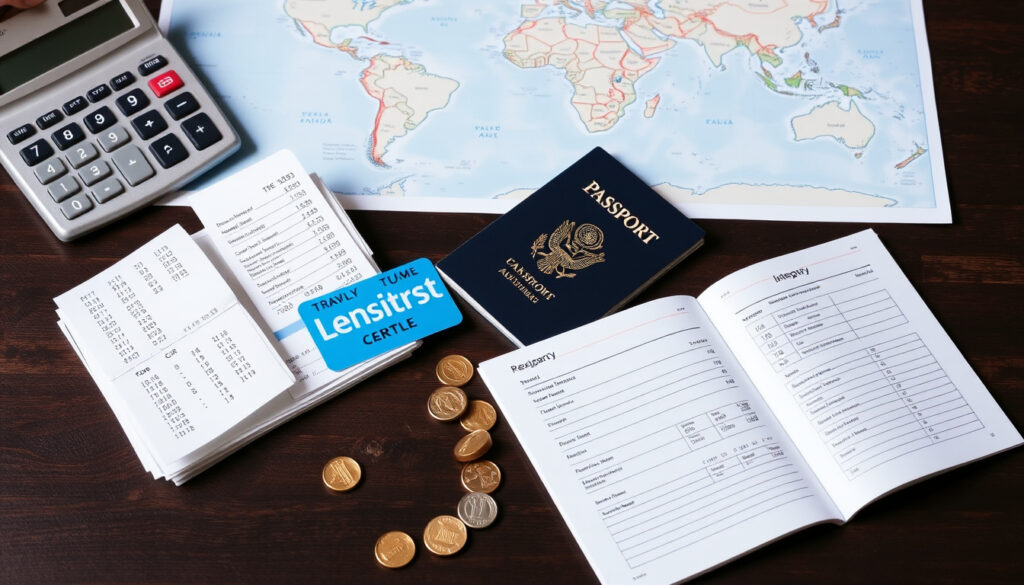
What Is Per Diem? Definition, Rates, and How It Works
You’re getting ready for a business trip and wonder: who pays for meals, and how much? That’s where per diem comes in — a daily allowance that covers expenses without requiring you to save every receipt. We’ll break down what per diem means, how it’s calculated, and the specific tax rules in Ireland that can save you money — or land you with a surprise bill if you get them wrong.
Definition: A daily allowance for work-related travel expenses covering lodging, meals, and incidentals ·
Common usage: Business travel reimbursement by employers ·
Tax treatment: Varies by country; often tax-free if within government-set limits
Quick snapshot
- Per diem is Latin for “per day” and refers to a daily allowance for travel expenses — Wikipedia (encyclopedic reference)
- Commonly covers lodging, meals, and incidentals during business travel — SHRM (HR resource)
- Whether per diem is taxable depends on specific circumstances and local regulations — IRS Publication 463 (US tax authority)
- The exact amount an employee receives can vary by employer policy — Investopedia (financial education)
- Government agencies typically publish updated per diem rates annually — U.S. General Services Administration (government travel office)
- Employees should review their employer’s per diem policy and ensure compliance with tax rules — Ramp (expense management platform)
Five key facts paint a clear picture of how per diem works across borders — one pattern: rates are set by government bodies, but the tax treatment hinges on specific conditions.
| Attribute | Value |
|---|---|
| Origin | Latin per diem = “by the day” — Wikipedia |
| Common coverage | Lodging, meals, incidental expenses — SHRM |
| Tax-free limit (US) | U.S. GSA per diem rates are generally tax-free if substantiated — IRS Publication 463 |
| Ireland 4-hour rule | Per diem is tax-free if travel exceeds 4 hours and stays within Revenue rates — Ireland Revenue Commissioners (tax authority) |
| Typical payment | Paid daily or as a lump-sum per trip — Rydoo (global expense compliance) |
| Ireland day allowance (5-10 hrs) | €19.25 — Rydoo citing Revenue table |
| Ireland day allowance (10+ hrs) | €46.17 — Rydoo citing Revenue table |
| Ireland overnight rate | €205.53 — Ireland Revenue Commissioners |
What is the meaning of per diem?
What does ‘per diem’ literally mean?
- Per diem is a Latin phrase meaning “per day” or “by the day.” In the workplace, it refers to a daily allowance paid to employees for expenses incurred during business travel — Wikipedia (encyclopedic reference)
- The term entered business usage in the mid-20th century as companies sought a standardized way to reimburse travel costs — Investopedia (financial education)
Why is it called per diem?
- Organizations adopted the Latin phrase to describe a fixed daily stipend that covers living expenses while traveling for work — Alvarez & Marsal (management consultancy)
- Unlike a salary (which is annual), per diem is explicitly tied to each day of travel — Ramp (expense management platform)
The label “per diem” isn’t just jargon — it signals a different accounting logic: the payment is tied to time away from the office, not to actual receipts. That shift in thinking is what makes per diem both simple and, at times, contentious.
Bottom line: Per diem is a Latin term for a daily allowance covering business travel expenses. For employers, it simplifies reimbursement. For employees, it means predictable cash — but only if the tax rules are followed.
The implication: getting the label right matters less than understanding the obligation it creates — employers who call a payment “per diem” still must prove tax compliance.
How does a per diem work?
How is a per diem paid?
- Employers provide a daily stipend either upfront (before travel) or as a reimbursement after the trip — SHRM (HR resource)
- The amount is usually based on government rates (like GSA in the U.S.) or company policy — Ramp (expense management platform)
- Payment can be made daily, weekly, or as a lump sum for the entire trip — Rydoo (global expense compliance)
Does per diem cover all expenses?
- Typically, per diem covers lodging, meals, and incidental expenses (tips, laundry, etc.) — SHRM
- Transportation costs (flights, rental cars) are generally reimbursed separately, not as part of the per diem — Investopedia
- Some employers allow employees to keep the difference if actual expenses are lower, while others require any excess to be returned — Simply Counted (accounting resource)
When an employer uses a fixed per diem, the employee gains freedom from receipt‑keeping. But that freedom can backfire if the per diem rate is lower than actual costs — the employee ends up subsidizing the trip.
Bottom line: Per diem works as a fixed daily allowance, usually based on government rates. It simplifies expense reporting but shifts risk: if costs are lower, the employee profits; if higher, they lose out.
What this means: employers who adopt the per diem model trade administrative ease for potential equity concerns among staff traveling to different destinations.
How to calculate per diem pay?
What is the standard per diem rate?
- Standard per diem rates are set by government agencies — for U.S. domestic travel, the GSA publishes updated rates annually — U.S. General Services Administration (government travel office)
- In Ireland, Revenue provides day and overnight subsistence rates: €19.25 for 5-10 hours, €46.17 for 10+ hours, and €205.53 overnight — Rydoo citing Revenue table
- Companies may adopt their own rates as long as they stay within tax-free limits — Alvarez & Marsal (management consultancy)
How to use government rates for calculation?
- Step 1: Identify the destination and travel dates. Check the relevant government rate for that location (e.g., GSA for US, Revenue for Ireland).
- Step 2: Determine the applicable per diem rate. For Ireland, use the day rate if the absence is 5+ hours and not within 8km of home/work; use the overnight rate if away from home overnight and >100km — Ireland Revenue Commissioners (tax authority)
- Step 3: Multiply the daily rate by the number of travel days. If partial days are involved, adjust by the rules (e.g., a half-day rate for less than 5 hours in Ireland is not tax-free).
- Step 4: Decide whether to pay the full per diem or a partial allowance. Many employers pay 75% of the standard rate for partial travel days.
- Step 5: Document the calculation. Revenue requires proper records to support tax-free treatment — Ireland Revenue Commissioners
The pattern is consistent: precise documentation separates a legitimate allowance from a taxable payment, especially when partial days are involved.
What is per diem in Ireland?
Is per diem taxable in Ireland?
- In Ireland, per diem‑style travel payments are treated as subsistence reimbursements. They are tax‑free only if they meet Revenue’s rules — Ireland Revenue Commissioners (tax authority)
- Revenue’s guidance distinguishes between day allowances (for absences of 5+ hours, >8km from home/work) and overnight allowances (away from home, >100km) — Ireland Revenue Commissioners
- If payments exceed the approved rates, the excess is taxable as income and subject to PAYE — Rydoo (global expense compliance)
What is the 4‑hour rule in Ireland?
- The term “4‑hour rule” is commonly used but Revenue’s actual threshold is 5 hours. A day allowance applies to continuous absences of five hours or more — Ireland Revenue Commissioners
- If the absence is less than 5 hours, or the location is within 8km of the employee’s home or normal workplace, any payment is considered taxable travel to work — Ireland Revenue Commissioners
- The overnight allowance requires overnight absence at a place more than 100km from both home and normal work location — Ireland Revenue Commissioners
Many employees assume a 4‑hour trip qualifies for a tax‑free per diem. Revenue says 5 hours — and the distance rule (8km from home/work) is equally strict. Get either wrong, and the entire payment becomes taxable income.
Bottom line: In Ireland, per diem payments are tax‑free only when they follow Revenue’s distance and duration rules (5+ hours for day allowance, overnight at >100km). The employer must keep proper records to justify the tax‑free treatment.
The catch for Irish employers: paying above Revenue thresholds converts a clean allowance into a payroll tax liability overnight.
Is it good to get paid per diem?
What are the pros and cons of per diem vs reimbursement?
Upsides
- Simplifies expense tracking — no need to save every receipt — Alvarez & Marsal
- Predictable cash flow for the employee during travel — Ramp (expense management)
- Can result in extra income if actual expenses are lower than the per diem — Simply Counted (accounting resource)
Downsides
- May create inequality — employees with lower travel costs benefit while those with higher costs lose out — Simply Counted
- Potential tax implications if the per diem exceeds approved government rates — Ireland Revenue Commissioners
- Per diem rates may not reflect actual costs in expensive cities, forcing employees to subsidize — SHRM
Bottom line: Per diem is good for employees who can spend below the fixed rate and value simplicity. For those traveling to high‑cost destinations or with special dietary needs, actual‑expense reimbursement may be fairer. Employers must decide which system aligns with their culture and tax compliance.
The pattern: the same mechanism that rewards frugal travelers penalizes those whose costs exceed the fixed rate, making geography the hidden variable in fairness.
What we know for sure
Here’s what the evidence confirms — and what remains uncertain about per diem arrangements.
Confirmed facts
- Per diem is a daily allowance for travel expenses — Wikipedia
- In Ireland, tax‑free subsistence depends on distance and duration rules — Ireland Revenue Commissioners
What’s unclear
- The exact tax treatment of per diem varies by jurisdiction and individual circumstances — IRS and Ireland Revenue Commissioners
- Whether a per diem arrangement is more cost‑effective for the employer than actual‑expense reimbursement depends on travel patterns and policy design — Alvarez & Marsal
- Whether government-set rates apply to all employers or only as guidelines varies by country and regulatory framework — derived from cross-jurisdiction patterns
Perspectives on per diem
Per diem is a specific amount of money that an organization gives an individual per day to cover living expenses when travelling.
Per diem is a daily stipend designated to cover expenses incurred by employees during business travel.
Frequently asked questions
What does per diem cover?
Per diem typically covers lodging, meals, and incidental expenses (tips, laundry, etc.). Transportation costs are usually reimbursed separately. — SHRM
Can per diem be used for personal travel?
No, per diem is specifically for business travel expenses. Using it for personal purposes may result in taxable income. — IRS Publication 463
How do I claim per diem on my taxes?
If your employer provides per diem under a compliant plan (e.g., GSA rates in the US), it is generally not reportable as income. Any excess over approved rates must be reported as wages. — IRS Publication 463
What is the difference between per diem and mileage reimbursement?
Per diem covers daily living expenses (meals, lodging). Mileage reimbursement covers the cost of using a personal vehicle for business travel. They are separate allowances. — Investopedia
Are per diem rates the same for all employees?
Not necessarily. Rates can vary by job role, seniority, or location. Some companies pay different rates for domestic vs. international travel. — SHRM
How often do per diem rates change?
Government rates (GSA, Revenue Ireland) are updated annually. Company‑specific rates may be reviewed less frequently. — GSA
What happens if I spend less than my per diem?
It depends on company policy. Some employers allow you to keep the surplus; others require repayment. In either case, the amount is generally tax‑free if it stays within approved limits. — Simply Counted
Per diem is a practical tool for simplifying travel expense management — but it’s not a free pass. For employers considering it, the decision hinges on whether the simplicity outweighs the potential for perceived inequality. For employees in Ireland, the clear rule is: stay within Revenue’s distance and duration thresholds, or watch a tax‑free allowance become a taxable payment. The smart move? Pair per diem with a clear policy, keep meticulous records, and review rates annually. For any Irish company implementing it, the choice is clear: design a system that matches Revenue’s rules, or risk an unwelcome tax bill that eats into both the company’s and the employee’s pockets.
More related posts
 Venezuela 2026 World Cup: Points Needed & Chances
 How Many Gram of Protein in an Egg? Your Daily Protein Guide
 Bill Belichick Net Worth 2025: Salary, Career Earnings & More
 Why Is Crypto Crashing Today? Key Reasons and Recovery Outlook
 Party Supply Store Near Me: Find the Best Local Shops in Ireland
 TPG Products SBTPG LLC Deposit: What It Means
 Brazil National Team Standings 2026: Rankings & Neymar Update
 Spin The Wheel Custom – Create for Classrooms and Giveaways
