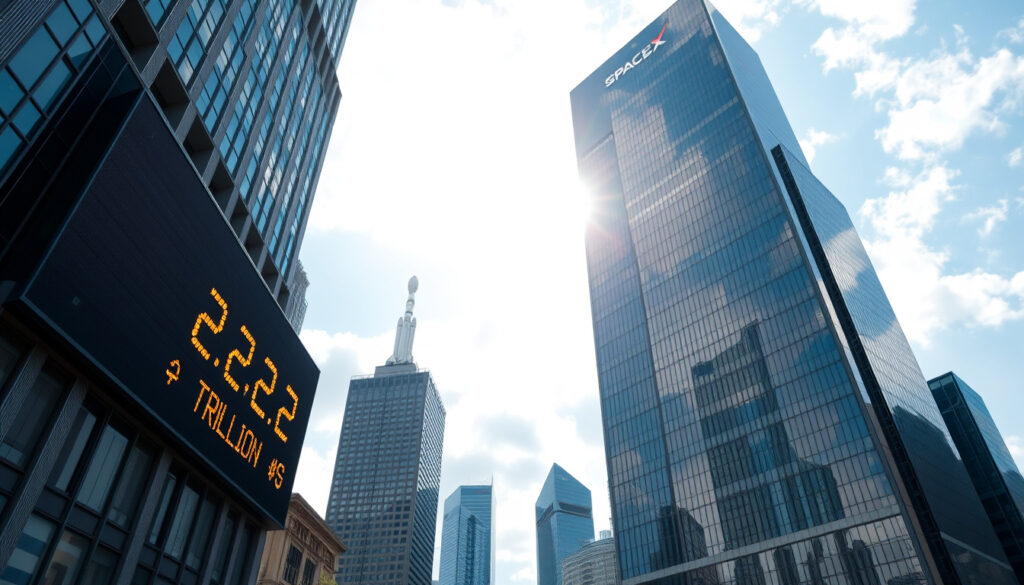
SpaceX’s Latest Valuation 2026: $2.2 Trillion After IPO
There’s a reason the phrase “space is hard” doesn’t apply to SpaceX’s stock price: when the company went public in June 2026, shares surged 22% above the IPO price within a week, pushing the valuation to nearly $2.2 trillion. But beneath the headline numbers, a more complicated story is unfolding about how much of that value is real.
Latest valuation (June 2026): $2.2 trillion (Yahoo Finance, financial data platform) ·
Market cap (August 2026): $1.84 trillion (Yahoo Finance) ·
IPO price: $135 per share (BBC News, UK public broadcaster) ·
Post-IPO share price range: $165–$170 (The Guardian, UK newspaper) ·
Valuation in 2022 funding round: $127 billion (Wikipedia, the free encyclopedia)
Quick snapshot
- SpaceX went public June 2026 at $135 per share (BBC News, UK public broadcaster)
- Market cap reached ~$2.2 trillion one week later (Yahoo Finance, financial data platform)
- Starlink is the only profitable segment (Reuters, global news agency)
- Whether the $2.2 trillion valuation is sustainable
- Exact profitability split between Starlink and launch services
- Full list of shareholders beyond Elon Musk
- Elon Musk’s ownership percentage – not publicly confirmed
- June 2026: IPO at $135, valuation peaks at $2.2 trillion (BBC News, UK public broadcaster)
- August 2026: Market cap settles to $1.84 trillion (Yahoo Finance, financial data platform)
- First quarterly earnings as a public company due soon
- Starship test flights and potential revenue from Mars missions
- Regulatory scrutiny of Starlink’s market dominance
Six valuation milestones, one pattern: SpaceX’s worth has exploded faster than its rockets. Here’s how the numbers stack up.
| Metric | Value |
|---|---|
| Latest valuation (June 2026) | $2.2 trillion |
| Market cap (August 2026) | $1.84 trillion |
| IPO price | $135 per share |
| Post-IPO share price range | $165 – $170 |
| 2022 valuation | $127 billion |
| 2025 private valuation | $800 billion (July) |
What is SpaceX’s true valuation?
How the valuation is calculated
- SpaceX’s IPO filing targeted a $1.75 trillion valuation including the greenshoe option (Reuters, global news agency).
- Shares were priced at $135, implying a valuation of roughly $1.75 trillion (BBC News, UK public broadcaster).
- One week after the IPO, the stock traded around $165, giving a market cap of nearly $2.2 trillion (The Guardian, UK newspaper).
Comparison of pre-IPO and post-IPO valuations
Two years before the IPO, SpaceX’s private valuation was $127 billion. By July 2025, a funding round valued it at $800 billion (Reddit community discussion, citing investor documents). The IPO valuation of $1.75 trillion was more than double that. But independent analysts at Morningstar pegged SpaceX’s fair value at $780 billion—roughly 48% below the private-market valuation of $1.5 trillion (CNBC, business news network).
Market cap vs. internal valuation
Market cap is what the stock market says a company is worth at any moment. Internal valuation (or “fair value”) is what analysts estimate using discounted cash flows, comparable companies, and risk. For SpaceX, the gap is huge: the market cap of $1.84 trillion (August 2026) is more than double Morningstar’s $780 billion estimate. The implication: the market is betting on growth that hasn’t yet materialized in earnings.
SpaceX’s valuation is a bet on the future, not a reflection of current profits. Morningstar’s $780 billion fair value suggests the stock is priced for perfection—and perfection is rare in space.
The pattern: the market is pricing in future Starlink and Starship success that has not yet appeared in earnings.
What is the latest valuation round for SpaceX?
Details of the July 2025 funding round
- In July 2025, SpaceX raised capital in a private round that valued the company at $800 billion (Reddit community discussion, citing SpaceX investor documents).
- The share price in that round was $212 per share.
- This was the last private funding before the 2026 IPO.
How the round valued SpaceX at $800 billion
The $800 billion valuation was based on the strong performance of Starlink, which by then was generating over $11 billion in annual revenue (Sacra, a research firm tracking private companies). Investors were willing to pay a premium for a piece of the Starlink story before the public market opened.
Impact of the round on share price
The $212 private share price was 57% higher than the eventual IPO price of $135. That discount—called the “IPO discount”—is typical, but the size of the gap surprised some analysts. The trade-off: early investors got in at $212, but public investors got a 36% discount to that private market price.
Private investors who bought at $212 per share are now underwater relative to the August 2026 market price of ~$165. The IPO discount didn’t protect them from the post-IPO dip.
What this means: the private market overpaid relative to the public market’s current valuation.
How much will SpaceX be worth when it goes public per share?
IPO pricing details ($135 per share)
- SpaceX’s IPO was priced at $135 per share, at the bottom of the indicated range (BBC News, UK public broadcaster).
- The offering consisted entirely of new shares, raising capital for the company (Reuters, global news agency).
Trading debut performance
On the first day of trading, shares opened at $165 and quickly rose to $170, a 26% pop from the IPO price (The Guardian, UK newspaper). Within a week, the stock settled around $165, still 22% above the IPO price (Yahoo Finance, financial data platform).
Comparison to pre-IPO share price
Pre-IPO private market shares traded at $212 in July 2025. That means public investors got a 36% discount to the last private price. But the stock’s subsequent decline to $165 means those private investors are now sitting on a 22% loss.
The pattern: the IPO discount was generous, but the post-IPO decline erased the gains for private buyers.
Is SpaceX going to be overvalued?
Arguments for overvaluation
- At a $1.75 trillion valuation, SpaceX was trading at a price-to-revenue multiple of 56 and a price-to-EBITDA multiple of 109 (Reuters, global news agency).
- Morningstar’s fair value of $780 billion is less than half the current market cap (CNBC, business news network).
- SpaceX posted a net loss of $4.28 billion in the latest quarter (CNBC, business news network).
Arguments for fair valuation
- Starlink’s revenue grew to $11.4 billion in fiscal 2025, 61% of total SpaceX revenue (Sacra, a research firm tracking private companies).
- Starlink generated $4.4 billion in operating profit (Sacra, a research firm tracking private companies).
- SpaceX reported about $8 billion in profit and $15–16 billion in revenue for 2025 (Reuters, global news agency).
- Elon Musk’s net worth exceeded $1 trillion post-IPO, signaling market confidence in the company’s long-term vision.
Comparison with other tech giants
At $1.84 trillion, SpaceX’s market cap is larger than Meta ($1.2 trillion) and Tesla ($800 billion), but smaller than Apple ($3.5 trillion) and Microsoft ($3.2 trillion). The pattern: SpaceX is valued like a mega-cap tech company, but its revenue base ($15–16 billion) is a fraction of those peers. The implication: the market is pricing in a future where Starlink and Starship generate tens of billions in revenue.
SpaceX is losing money on its core launch business while Starlink prints cash. If Starlink’s growth slows, the entire valuation case collapses. If Starship succeeds, the upside is enormous.
The catch: the valuation hinges on Starlink’s continued growth and Starship’s eventual success.
Is SpaceX profitable without Starlink?
SpaceX’s main revenue streams
- Launch services (government and commercial contracts) — historically the main revenue driver.
- Starlink broadband — now the largest segment by revenue.
- Potential future: Starship cargo, human spaceflight, Mars missions.
Starlink’s contribution to profitability
According to Reuters, Starlink is SpaceX’s only profitable segment. The connectivity business generated $11.4 billion in revenue and $4.4 billion in operating profit in fiscal 2025 (Sacra, a research firm tracking private companies). Meanwhile, the rest of SpaceX (launch services, crew dragon, Starship development) is burning cash. Reuters reported that “SpaceX’s other businesses were burning cash while Starlink generated profits” (Reuters, global news agency).
Launch service margins
Launch service margins are not publicly disclosed, but industry estimates suggest they are thin due to high R&D costs. The net loss of $4.28 billion in the latest quarter (CNBC, business news network) indicates that the company is spending heavily on Starship development and new launch infrastructure.
The implication: Starlink’s profitability is the linchpin of the entire valuation.
Timeline: SpaceX valuation milestones
- 2022 — Funding round values SpaceX at $127 billion (Wikipedia, the free encyclopedia).
- July 2025 — Private round sets valuation at $800 billion, share price $212 (Reddit community discussion, citing investor documents).
- June 2026 — SpaceX goes public at $135 per share, valuation peaks at $2.2 trillion (The Guardian, UK newspaper).
- August 2026 — Market cap settles around $1.84 trillion (Yahoo Finance, financial data platform).
Confirmed facts
- SpaceX went public in June 2026 at $135 per share (BBC News, UK public broadcaster, Yahoo Finance, financial data platform).
- Pre-IPO valuation in July 2025 was $800 billion (Reddit community discussion, citing investor documents).
- Starlink is the only profitable segment (Reuters, global news agency).
- Starlink generated $11.4B revenue and $4.4B operating profit in fiscal 2025 (Sacra, a research firm tracking private companies).
What’s unclear
- Whether the $2.2 trillion valuation is sustainable.
- Exact profitability split between Starlink and launch services (not publicly disclosed).
- Full list of shareholders beyond Musk.
- How much of the recent net loss is due to Starship R&D versus operational costs.
- Elon Musk’s exact ownership percentage – not publicly confirmed.
What the analysts are saying
“SpaceX’s valuation is hovering around $2.2tn.”
— The Guardian, reporting on IPO day
“The stock is about 22% above the IPO price of $135 per share.”
— Yahoo Finance, one week after the IPO
“Starlink is SpaceX’s only profitable segment.”
— Reuters, quoting the IPO filing
“Morningstar valued SpaceX at $780 billion, far below the IPO target.”
— CNBC, citing Morningstar’s analysis
For investors in the public market, the choice is clear: buy into the Starlink story and accept the risk that the rest of SpaceX is a cash-burning science project, or wait for the starship economics to prove themselves. If Starlink’s growth slows, the $2.2 trillion valuation will look like a peak. If Starship succeeds, today’s price will be a bargain. For Elon Musk, the IPO was a liquidity event. For everyone else, it’s a bet on whether the man who built the world’s most valuable space company can also build the world’s most valuable satellite operator.
Related reading: How to Make Money on YouTube: 2026 Complete Guide for Beginners
cnbc.com, tradingkey.com, softwareseni.com, morningstar.com, mexc.com, reuters.com, itiger.com
Frequently asked questions
What is SpaceX’s valuation as of 2026?
SpaceX’s valuation reached $2.2 trillion in June 2026 after its IPO, but by August 2026 the market cap had settled to around $1.84 trillion.
How does SpaceX’s market cap compare to its IPO valuation?
The IPO valuation was $1.75 trillion at $135 per share. The market cap rose to $2.2 trillion within a week, then declined to $1.84 trillion.
Who owns the majority of SpaceX?
Elon Musk is the largest shareholder, but he does not own 100% of the company. The full shareholder list is not publicly disclosed.
Is SpaceX profitable?
Overall, SpaceX is profitable on an annual basis (about $8 billion profit in 2025), but it posted a net loss of $4.28 billion in the latest quarter due to heavy investment in Starship.
What is the difference between valuation and market cap?
Valuation generally refers to the estimated worth of a company (often from funding rounds), while market cap is the publicly traded stock price multiplied by total shares outstanding. They can differ significantly.
How does Starlink affect SpaceX’s valuation?
Starlink is the main driver of SpaceX’s valuation. It generated $11.4 billion in revenue in fiscal 2025 and is the only profitable segment. Without Starlink, the valuation would be much lower.
Could SpaceX be overvalued?
Some analysts, like Morningstar, believe SpaceX’s fair value is around $780 billion—less than half the current market cap. The high price-to-revenue and price-to-EBITDA multiples support the overvaluation argument.
More related posts
 Where Does Charlie Kirk Live? Arizona Home & New York Move
 Best Free English to Spanish Translators: Google, DeepL, Reverso
 Cetaphil Gentle Skin Cleanser: Is It Good for Your Face
 Wicked (2024 Film): Top Fan Questions Answered
 City of Chicago Jobs: Official Openings and Application Guide
 1923 Season 2 Episode 7: Spoilers, Recap & Baby’s Fate
 How Many Fluid Ounces in a Gallon? 128 oz Guide + Chart
