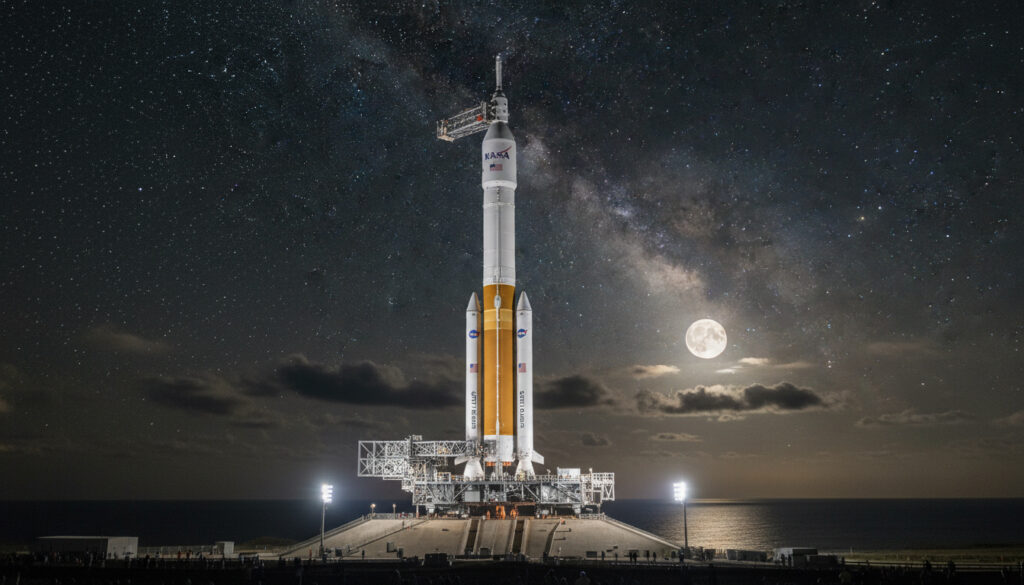
Back to the Frontier – NASA Artemis Moon Mission Update
Humanity stands at the threshold of a renewed lunar era. NASA’s Artemis program, launched in 2020 alongside the Artemis Accords, represents a collaborative U.S.-led effort to return astronauts to the Moon’s surface, establish sustainable presence through the Lunar Gateway, and prepare for Mars exploration. The initiative builds upon Apollo-era foundations while employing modern systems including the Space Launch System and SpaceX’s Starship.
The program has already achieved significant milestones. Artemis I completed an uncrewed circumlunar flight in 2022, while the current Artemis II mission, launched April 1, 2026, carries four astronauts farther from Earth than any humans since 1972. This 10-day flight validates critical systems for future landings.
With over 60 nations signed to the Artemis Accords and partnerships spanning NASA, the Canadian Space Agency, and commercial contractors, the effort marks a shift from short-term lunar visits to enduring settlement. The return to this final frontier promises scientific discovery, resource utilization, and a stepping stone toward deep space.
What Is NASA’s Artemis Program?
Moon to Mars initiative formalized 2020 alongside Artemis Accords
Artemis II crewed flight in progress (launched April 2026)
NASA, SpaceX, CSA, international partners
Sustainable lunar presence, Mars preparation
Key Insights
- The Artemis Accords establish civil space exploration governance among 60+ signatory nations
- Space Launch System (SLS) serves as the world’s most powerful rocket for Orion crew launches
- SpaceX’s Starship provides the human landing system for lunar surface missions
- Artemis II represents the first crewed mission in lunar vicinity since Apollo 17 in 1972
- The Lunar Gateway will enable annual missions and deep space staging post-2028
- South Pole targeting aims to utilize water ice resources for sustained presence
| Fact | Details | Source |
|---|---|---|
| Program Origin | NASA Moon to Mars initiative, formalized 2020 | NASA |
| Lead Agency | NASA | NASA |
| Primary Contractors | SpaceX (Starship), Orion manufacturers | Multiple |
| Current Mission | Artemis II (launched April 1, 2026) | NASA/Space.com |
| Crew Size | 4 astronauts (Artemis II) | NASA |
| Maximum Distance | Up to 232,000 miles from Earth | Space.com |
| Rocket System | Space Launch System (SLS) | Natural History Museum |
| Landing System | SpaceX Starship (future missions) | NASA |
| International Partners | 60+ nations via Artemis Accords | NASA |
| Mission Duration | 10 days (Artemis II) | NASA |
Who Are the Architects of the Lunar Return?
The Artemis Accords and Global Framework
The program originated from NASA’s Moon to Mars initiative, formalized with the Artemis Accords in 2020 by NASA, the U.S. Department of State, and initial signatories. The Accords now include over 60 nations, establishing multilateral principles for civil space exploration distinct from earlier bilateral agreements. This framework governs lunar activities and resource utilization while fostering transparency and interoperability.
The Artemis Accords now include over 60 signatory nations, establishing a multilateral framework for civil space exploration distinct from earlier bilateral space agreements.
NASA and Commercial Partnerships
Core partners include NASA as the leading agency, SpaceX developing the Starship human landing system, and the Canadian Space Agency (CSA) contributing astronauts and technology. Contractors manufacture the Orion spacecraft and SLS rocket components. Key missions leverage the SLS for Orion launches while Falcon Heavy rockets will deploy Gateway modules. This public-private model represents a fundamental shift from the purely governmental Apollo approach.
How Is the Return Technically Structured?
The Space Launch System and Orion
The Space Launch System stands as the world’s most powerful rocket, launching Orion with crew and cargo capabilities surpassing any current operational vehicle. Orion performs translunar injection, carries life support systems, and tests navigation technologies required for deep space operations. Artemis II validates these systems under crewed conditions for the first time.
Starship and the Lunar Gateway
SpaceX’s Starship provides the human landing system for surface missions beginning with Artemis III. The Lunar Gateway—a Moon-orbiting station—will serve as a staging point for surface operations and Mars preparation. Gateway modules launch via Falcon Heavy, arriving approximately one year after deployment. Greek God of War – Ares Myths, Symbols, Battles represents the mythological namesake connecting ancient exploration themes to modern celestial frontiers.
What Is the Current Status of Artemis II?
Artemis II launched April 1, 2026, from Kennedy Space Center Pad 39B following detailed countdown procedures including stage powering and battery charges with holds at L-40M and L-25M intervals. The crew—NASA astronauts Reid Wiseman, Victor Glover, and Christina Koch alongside CSA astronaut Jeremy Hansen—represents the first human lunar vicinity mission since Apollo 17.
Orion performed translunar injection on April 2, entering the Moon’s sphere of influence on April 6 at approximately 39,000 miles distance. The spacecraft traveled up to 232,000 miles from Earth during approach. As of April 6, the crew conducts flyby operations while testing SLS, Orion, communications, navigation, and life support systems. Splashdown is planned for April 10, concluding the 10-day flight. Mission updates confirm the vehicle is validating systems required for future landings.
As of April 6, 2026, the Artemis II crew is operating within the Moon’s sphere of influence, validating deep space communication and navigation systems required for future landing missions.
Artemis II remains a 10-day test flight without lunar landing capability; surface operations await Artemis III’s Starship integration targeted for late 2028.
When Did the Program Begin and Where Is It Headed?
-
Artemis program launches alongside Artemis Accords formalized by NASA and U.S. Department of State
-
Artemis I completes uncrewed 25-day mission; Orion travels 2.3 million km around Moon before December splashdown
-
Artemis II launches with four astronauts aboard SLS from Kennedy Space Center Pad 39B
-
Translunar injection propels Orion toward lunar sphere of influence
-
Crew enters Moon’s sphere of influence at ~39,000 miles; first human presence since 1972
-
Planned splashdown concludes 10-day mission after system validation
-
Artemis III targets first South Pole landing using Starship for ~1 week surface exploration
-
Artemis IV docks with Lunar Gateway; annual missions planned using upgraded SLS
What Facts Are Established Versus What Remains Uncertain?
Verified Information
- Artemis I successfully completed uncrewed lunar circumnavigation in December 2022
- Artemis II launched April 1, 2026 with four-person crew
- SLS and Orion systems have passed critical flight tests
- Artemis Accords signed by over 60 nations
- Current crew is operating in lunar space as of April 2026
Pending Confirmation
- Exact launch date for Artemis III (targeted late 2028, subject to Starship readiness)
- Lunar Gateway module arrival timelines (approximately one year post-launch)
- Specific geological survey results from South Pole region
- Annual mission cadence sustainability post-2028
- Resource extraction viability for water ice utilization
Why Does Returning to the Moon Matter?
The Artemis program enables sustainable lunar presence for scientific research and resource utilization, particularly targeting the South Pole where water ice deposits could support life support systems and fuel production. Natural History Museum analysis indicates these resources represent critical infrastructure for long-term settlement beyond brief Apollo-style visits.
Strategically, the Moon serves as a stepping stone for Mars exploration via the Gateway station—a platform for surface operations and deep space preparation. The architecture allows annual missions post-2028, creating continuous human presence rather than isolated expeditions. Greek God of War – Ares Myths Family Symbols illustrates humanity’s enduring fascination with celestial conflict and exploration, mirrored in modern efforts to establish dominion over the lunar frontier.
The program fosters unprecedented international and private collaboration under the Accords framework, establishing governance models for space resource utilization. This multilateral approach contrasts sharply with the Cold War bilateral competition of the Apollo era, potentially ensuring more sustainable long-term presence through shared infrastructure and cost distribution.
What Have Officials and Experts Stated?
“Launching the Artemis II Moon rocket will lift off the agency’s first crewed mission under the Artemis program, testing the systems that will return astronauts to the Moon for an enduring presence, and paving the way to human exploration of Mars.”
Experts characterize the program as a “key step toward long-term return to the Moon and future missions to Mars,” noting it revives lunar exploration capabilities dormant since the Apollo 17 mission in 1972. The NASA Artemis portal emphasizes the shift from temporary visits to enduring presence enabled by Gateway infrastructure and international partnership.
What Lies Ahead for Lunar Exploration?
The Artemis program represents humanity’s structured return to the lunar frontier after five decades, combining governmental leadership with commercial innovation. Through validated flight systems, international partnerships, and a clear trajectory from orbital testing to surface settlement, the initiative establishes foundational infrastructure for sustainable lunar presence and eventual Mars exploration. The current Artemis II mission demonstrates that the return is not merely aspirational but actively underway, with systems testing confirming readiness for the South Pole landings that will follow.
Frequently Asked Questions
What are the Artemis Accords?
The Artemis Accords are multilateral agreements established in 2020 by NASA and the U.S. Department of State to govern civil space exploration principles. Over 60 nations have signed, creating a framework for international lunar and deep space cooperation.
How does Artemis differ from Apollo?
Unlike Apollo’s brief visits, Artemis aims for sustainable presence via the Lunar Gateway, international partnerships, and commercial contractors like SpaceX. Missions target the South Pole for resource utilization rather than equatorial regions.
What role does SpaceX play in the Artemis program?
SpaceX provides the Starship human landing system for surface missions beginning with Artemis III. The company also launches Gateway modules using Falcon Heavy rockets.
Who comprises the Artemis II crew?
The crew includes NASA astronauts Reid Wiseman, Victor Glover, and Christina Koch, plus Canadian Space Agency astronaut Jeremy Hansen.
When will humans land on the Moon again?
Artemis III targets late 2028 for the first crewed lunar landing since 1972, utilizing SpaceX’s Starship to reach the South Pole for approximately one week of exploration.
What is the Lunar Gateway?
The Gateway is a Moon-orbiting station serving as a staging point for surface operations and deep space preparation. Modules launch via Falcon Heavy, with docking operations beginning Artemis IV.
How long does the Artemis II mission last?
Artemis II is a 10-day flight testing Orion and SLS systems without lunar landing, splashing down April 10, 2026, following its April 1 launch.
More related posts
 TPG Products SBTPG LLC Deposit: What It Means
 Indian in the Cupboard: Summary, Moral, and Age Guide
 Scalloped Potatoes and Ham: The Best Easy Recipe & Common Mistakes
 HBO Harry Potter Casts Arabella Stanton as Hermione Granger
 C’est la Vie Meaning: Literal Translation, Tone, and Usage
 Shaboozey ‘A Bar Song (Tipsy)’: Sample, Meaning & Record Success
 Apple Watch Blood Pressure: Hypertension Alerts Guide
 Easy Greek Recipes at Home – 10 Simple Dishes for Dinner
