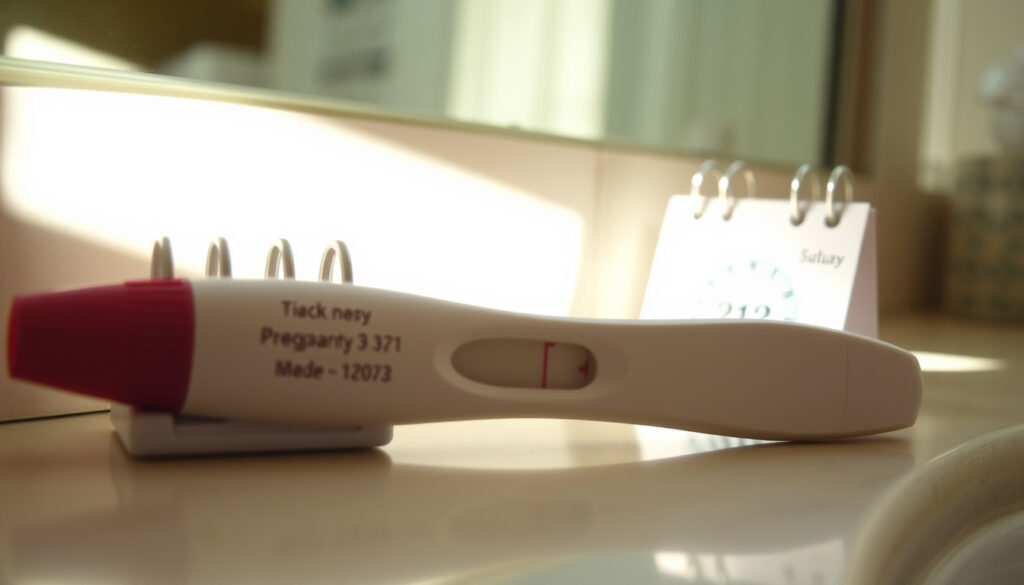
How Soon Will a Pregnancy Test Read Positive? Timing Guide
Anyone staring at a pregnancy test knows the wait feels endless—especially when you’re testing before a missed period. The truth is, how soon a test reads positive depends on your body’s hCG levels and the sensitivity of the test itself.
Pregnancies detected 6 days before missed period (Clearblue): 71% ·
hCG production begins (NHS): 6 days after fertilization ·
Earliest positive result (Cleveland Clinic): 10 days after conception ·
Recommendation for accuracy (HSE): Wait until missed period
Quick snapshot
- hCG begins about 6 days after fertilization (StatPearls / NCBI Bookshelf)
- 71% of pregnancies detected 6 days before missed period with Clearblue (Clearblue)
- Waiting until missed period increases accuracy (HSE)
- Exact day of implantation varies between women
- Individual hCG levels vary, affecting detection timing
- Some tests may have different sensitivity thresholds not disclosed
- Impact of irregular cycles on test timing is not well studied
- Day 0: Conception (StatPearls / NCBI Bookshelf)
- Day 6: hCG production begins (StatPearls / NCBI Bookshelf)
- Day 10-14: Early positive possible (Clearblue)
- Day 14: Missed period (most tests accurate) (Cleveland Clinic)
- Positive test? Confirm with a healthcare provider (Cleveland Clinic)
- Negative but still suspect? Retest after a few days or see a doctor (Cleveland Clinic)
Here are the key facts at a glance.
| Label | Value |
|---|---|
| Earliest detection | 6 days before missed period (71% detection with early tests) |
| hCG onset | ~6 days after fertilization (StatPearls / NCBI Bookshelf) |
| Common early positive | 10-14 days after conception (Cleveland Clinic) |
| Most accurate timing | After missed period (HSE) |
| Test duration | Most tests show results within 3-5 minutes |
What is the soonest a pregnancy test will be positive?
There’s a gap between what manufacturers advertise and what your body actually needs. Let’s break it down.
How many days after ovulation can a test detect hCG?
- hCG starts appearing in tiny amounts in urine around 7–9 days after ovulation (Clearblue).
- Blood tests can detect hCG earlier—some as soon as 6–8 days after ovulation (One Day Tests).
- But home urine tests usually need hCG levels of 20–50 mIU/mL to turn positive (StatPearls / NCBI Bookshelf).
What is the earliest day to take a test?
Some sensitive tests claim detection 6 days before your missed period (that’s around 8 days after ovulation). The catch: only about 71% of pregnancies are detected that early. For most women, waiting until the day of the missed period pushes accuracy above 99% (NHS).
Testing early gives you an answer days sooner, but it often delivers a false negative because your hCG isn’t high enough yet. For a woman trying to conceive, that emotional roller coaster may not be worth it.
The pattern: early testing sacrifices a lot of confidence for a small gain in time.
Is 7 days too early for a pregnancy test?
Short answer: yes, for most women. Here’s why.
Can I take a test at 7 days past ovulation?
- At 7 days past ovulation, implantation may have just occurred and hCG is still very low (UCSF Health).
- Even sensitive urine tests will miss many pregnancies at this stage (MedlinePlus).
- Blood tests (quantitative hCG) may pick up the pregnancy as early as 6–8 days after ovulation (One Day Tests).
What are the accuracy rates at 7 days?
No major manufacturer publishes accuracy at exactly 7 days past ovulation. The data we have: Clearblue detects 71% at 6 days before missed period, which corresponds to about 8 days past ovulation. At 7 days, the detection rate would be even lower. Waiting until the day of the missed period is recommended by the HSE for highest accuracy.
The pattern: early testing sacrifices a lot of confidence for a small gain in time.
If you test at 7 days and get a negative, you might still be pregnant. Many women get a false negative and then assume they’re not, delaying important prenatal care (Cleveland Clinic).
The implication: testing before 8 days past ovulation is unreliable; waiting a few more days increases confidence dramatically.
How soon will a pregnancy test read positive after a missed period?
After a missed period, the picture gets much clearer.
Can a test be positive before a missed period?
- Yes, some sensitive tests claim detection up to 6 days before your missed period.
- The detection rate at that point is about 71%, meaning 29% of pregnant women will get a false negative.
What is the detection rate after a missed period?
Once your period is late—typically 14 days after conception (Cleveland Clinic)—most home tests claim over 99% accuracy (NHS). hCG levels are usually above the 20–50 mIU/mL threshold needed for a robust positive (American Pregnancy Association).
Waiting until after a missed period eliminates most false negatives. The stress of an extra few days often pays off with a reliable result.
How long do pregnancy tests usually take to show positive?
Once you take the test, the result appears in minutes—but how long it took for hCG to get there is a different story.
How many minutes does it take to see results?
- Most home urine tests give a result within 3–5 minutes (check your specific test instructions).
- Reading after 10 minutes may give a false positive due to evaporation lines (MedlinePlus).
How long after conception does hCG appear?
hCG appears in the blood about 10 days after conception (Labcorp OnDemand). It reaches urine levels detectable by home tests a day or two later. The doubling time is roughly every 72 hours (American Pregnancy Association), so a test on day 10 may be negative while day 14 is clearly positive.
What this means: waiting until after a missed period gives hCG enough time to reach detectable levels, reducing false negatives.
Am I really pregnant?
When the stick says one thing but your body says another, it’s confusing. Here’s how to handle it.
What to do if you get a positive result?
- Confirm with a healthcare provider—a urine test at the doctor’s office or a quantitative blood test.
- Start prenatal care: take folic acid, avoid alcohol, and schedule an appointment.
What if you get a negative but still have symptoms?
You could still be pregnant if you tested too early. hCG levels double about every 72 hours (American Pregnancy Association), so retest in 2–3 days. MedlinePlus recommends repeating a negative test one week later if you still suspect pregnancy. Also, use first morning urine for highest concentration.
A negative test after a missed period usually means you’re not pregnant—but if hCG is very low due to a very early miscarriage or ectopic pregnancy, you might still have symptoms. Always follow up with a doctor if symptoms persist.
The takeaway: a single negative test is not definitive; retesting after a few days provides clarity.
From conception to positive: the timeline
Fertilization occurs.
Implantation typically occurs; hCG starts to rise (StatPearls / NCBI Bookshelf).
Some sensitive tests may detect hCG in urine.
Most home tests give accurate results.
Accuracy >99% for most home tests (NHS).
What we know vs. what we don’t
Confirmed facts
- hCG begins about 6 days after fertilization (StatPearls / NCBI Bookshelf)
- 71% of pregnancies can be detected 6 days before missed period with Clearblue
- Waiting until missed period increases accuracy (HSE)
- Home tests detect hCG at 20–50 mIU/mL
- Blood tests can detect earlier, around 10 days after conception
What’s unclear
- Exact day of implantation varies between women
- Individual hCG levels vary, affecting detection timing
- Some tests may have different sensitivity thresholds not disclosed
- Impact of irregular cycles on test timing is not well studied
What the experts say
“Home urine pregnancy tests generally detect hCG at thresholds around 20 to 50 mIU/mL, though some assays can detect lower levels.”
StatPearls / NCBI Bookshelf
“Clearblue states that hCG can be detected in blood around eight days after the estimated day of conception using the most sensitive laboratory methods. hCG starts to appear in tiny amounts in urine around 7 to 9 days after ovulation.”
Clearblue
“Home urine tests can detect hCG about 10 days after conception, but testing after a missed period reduces the chance of a false negative.”
Cleveland Clinic
For any woman trying to conceive, the choice between testing early and waiting for a missed period is a trade-off between speed and certainty. Testing too early risks a false negative that can cause needless worry and delay prenatal care. The data is clear: wait until after your missed period for the most reliable result, or accept that an early negative may not be definitive. For women with irregular cycles, the safest bet is to test once a week until you get a positive or a period.
Related reading: Can You Get Pregnant When Not Ovulating? Facts & Myths · Signs of Yeast Infection – Symptoms in Women and Men
Frequently asked questions
Can a pregnancy test give a false positive?
Yes, but it’s rare. False positives can be caused by certain medications, medical conditions, or a very early miscarriage (chemical pregnancy) (MedlinePlus).
What is the best time of day to take a pregnancy test?
First morning urine usually contains the highest concentration of hCG, making it the best time for early testing.
How long after implantation can I test?
Implantation typically occurs 6–12 days after ovulation. hCG starts rising immediately, but it takes a few days to reach detectable levels in urine. Testing at least 2 days after implantation gives a better chance.
Are digital pregnancy tests more sensitive?
Not necessarily. Digital tests often have the same or higher detection thresholds (around 25 mIU/mL) compared to some non-digital ones (6.3 mIU/mL). Check the box for sensitivity.
What should I do if my test is negative but I still think I’m pregnant?
Wait 2–3 days and test again with first morning urine. If still negative after a week, see your doctor for a blood test.
How soon will a pregnancy test read positive after a miscarriage?
hCG levels take time to fall after a miscarriage. It can take several weeks for a test to become negative again. Follow your doctor’s advice on when to expect a negative result (American Pregnancy Association).
More related posts
 Espanyol vs FC Barcelona Lineups: Predicted XI & Team News
 Spin The Wheel Custom – Create for Classrooms and Giveaways
 Pac-12 Conference 2026: Teams, History, and Realignment
 Sacramento Kings vs Cleveland Cavaliers Player Stats
 How to Remove Acrylic Nails Without Damaging Natural Nails
 Back to the Frontier – NASA Artemis Moon Mission Update
 CFB 26 Release Date: EA College Football 26 Launch Info
 What Is Per Diem? Definition, Rates, and How It Works
